Council of Nicaea
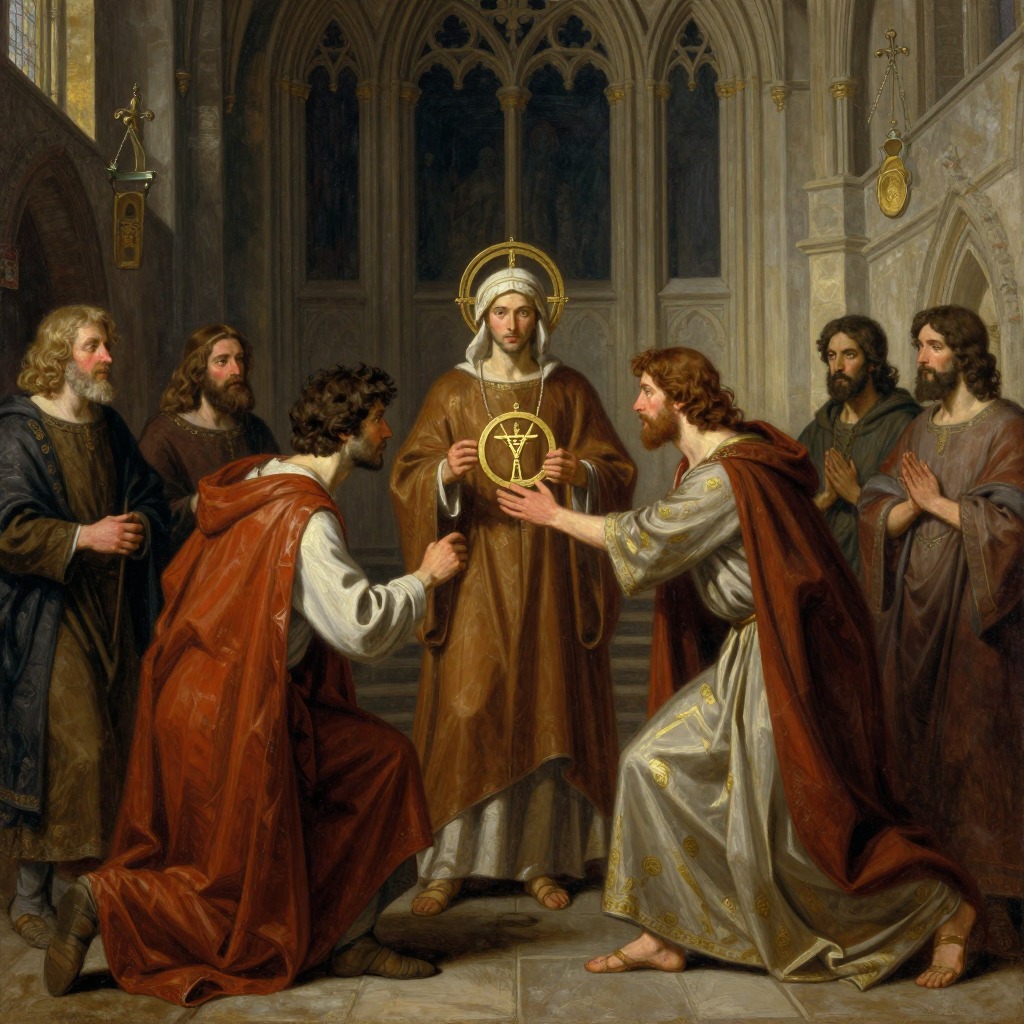
The Council of Nicaea, convened in 325 A.D. by the Roman Emperor Constantine the Great, is depicted in The Da Vinci Code as the single most consequential act of historical revisionism in the Christian tradition. According to the novel's central thesis, this ecumenical gathering was not a solemn deliberation on divine truth but a calculated political maneuver to unify a fracturing Roman Empire under a single, state-sanctioned religion. The council's most critical and controversial decision, the novel argues, was the official establishment of Jesus Christ as the divine Son of God, a status that was not universally accepted among his early followers but was instead proposed and voted upon by the attending bishops.
The Political Context and Constantine's Motives
The novel frames Constantine's decision to convene the Council of Nicaea as a pragmatic solution to a growing religious crisis. In the early fourth century, the Roman Empire was torn by conflict between pagans and the rapidly multiplying followers of Christ. Constantine, a lifelong pagan who was baptized only on his deathbed, saw Christianity as the winning horse and sought to unify Rome under a single religion. To make this new state religion palatable to the pagan majority, he fused pagan symbols, dates, and rituals into the growing Christian tradition, creating a hybrid faith. The council was the instrument through which he could solidify this new orthodoxy, and the most crucial element was the elevation of Jesus from a mortal prophet to a divine being, a move that would place the Church as the sole intermediary between humanity and God.
The Vote on Jesus' Divinity
The novel asserts that before the Council of Nicaea, Jesus was widely viewed by his followers as a mortal prophet—a great and powerful man, but a man nonetheless. The council's official vote to establish his divinity was a close one, but its outcome was decisive. By officially endorsing Jesus as the Son of God, Constantine transformed him into a deity whose power was unchallengeable, thereby precluding further pagan challenges to Christianity and ensuring that followers of Christ could only find redemption through the established sacred channel of the Roman Catholic Church. This act, the novel claims, was a power grab by the early Church, which hijacked Jesus' human message and shrouded it in an impenetrable cloak of divinity to expand its own power.
The Suppression of the Sacred Feminine
The Council of Nicaea is presented as the catalyst for the systematic suppression of the sacred feminine. The novel argues that Constantine's new Bible omitted gospels that spoke of Christ's human traits, particularly his marriage to Mary Magdalene, and embellished those that made him godlike. The earlier gospels were outlawed, gathered up, and burned. This was a direct attack on the figure of Mary Magdalene, who, according to the novel, was not a prostitute but the wife of Jesus and the bearer of his royal bloodline—the Holy Grail. The Church needed to defame her to cover up her dangerous secret and to eliminate the threat posed by a mortal bloodline to the doctrine of Christ's divinity. The council's decisions thus set in motion a centuries-long campaign to demonize the sacred feminine, recasting pagan symbols of the goddess as evil and erasing women from positions of spiritual authority.
The Council's Legacy in the Novel's Narrative
The legacy of the Council of Nicaea permeates the entire plot of The Da Vinci Code. The Priory of Sion, the secret society that guards the secret of the Holy Grail, is portrayed as the keeper of the truth that the council sought to destroy. The novel's protagonists, Robert Langdon and Sophie Neveu, are on a quest to uncover this truth, which is encoded in the works of Leonardo da Vinci and other artists. The council's actions are the original sin that the novel's conspiracy seeks to rectify, and the ultimate revelation of the Grail's location is presented as a vindication of the sacred feminine against the patriarchal power structure established at Nicaea. The novel's entire narrative engine is driven by the idea that the Council of Nicaea was a foundational act of deception, the consequences of which are still being felt in the modern world.